
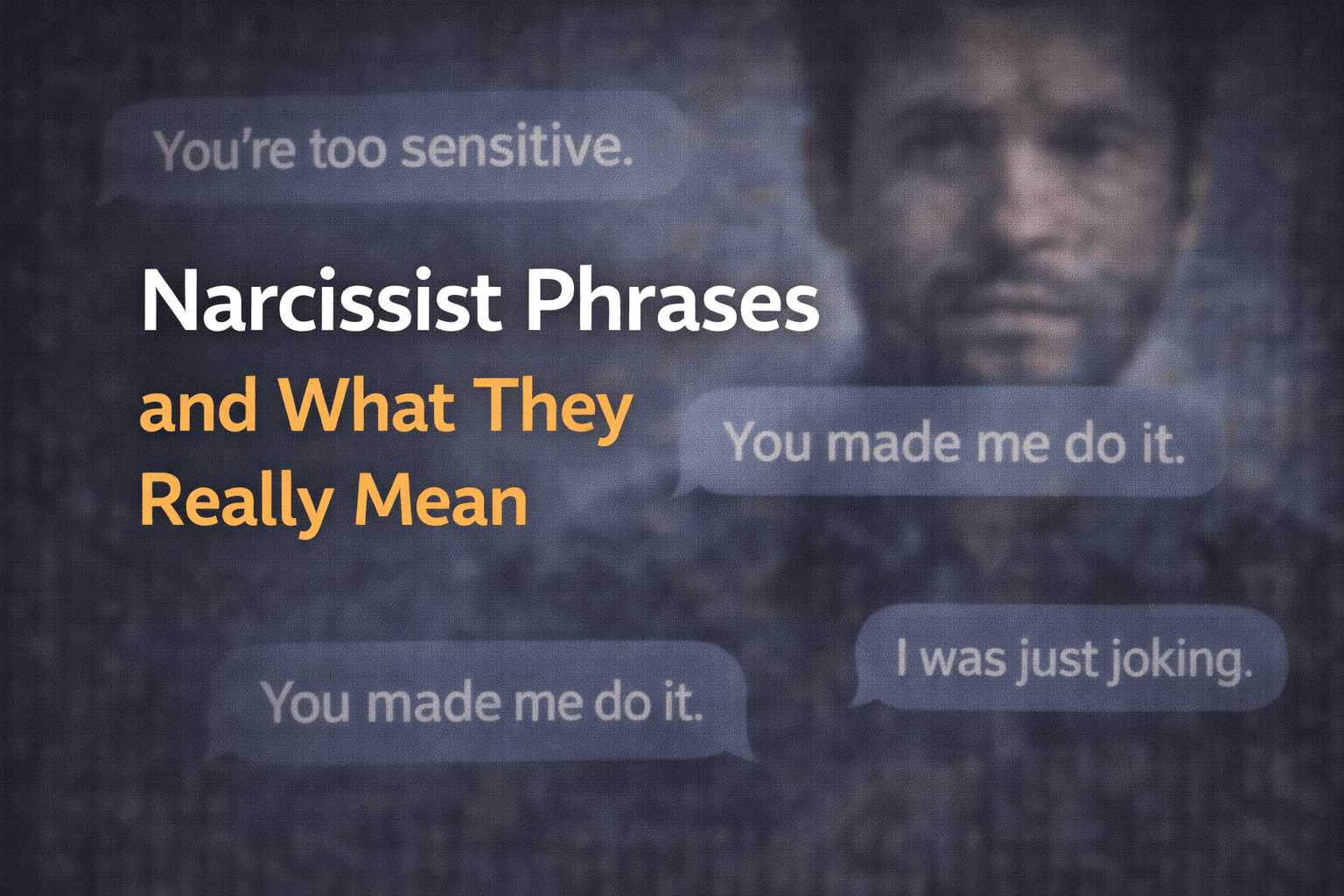
Some of the most damaging parts of narcissistic abuse are not always loud or obvious. Often, the manipulation happens through repeated phrases that create confusion, guilt, self-doubt, and emotional pressure over time.
That is why learning common narcissist phrases matters. When you understand what these phrases really mean, it becomes easier to spot manipulation, protect your peace, and respond more clearly.
In this guide, you will learn common narcissist phrases, what they often mean underneath the surface, and how to respond without getting pulled deeper into the same cycle.
Why Narcissistic Phrases Are So Confusing
Narcissistic phrases are often effective because they sound normal on the surface. Some may even sound caring, reasonable, or emotional at first.
But when they are used repeatedly in unhealthy dynamics, they often serve a different purpose.
They Create Self-Doubt
Many manipulative phrases are designed to make you question your memory, judgment, or emotional reactions.
They Shift Blame
Instead of taking responsibility, the speaker redirects attention back onto you.
They Create Guilt
You may start feeling selfish, cruel, dramatic, or unreasonable for having normal needs or boundaries.
They Keep You in the Cycle
Repeated phrases can pull you back into defending yourself, over-explaining, or trying to earn fairness from someone committed to control.
If you have already read our guide on what is gaslighting, signs, examples, and how to respond, you may notice that many narcissist phrases work by distorting reality and making you doubt yourself.
Common Narcissist Phrases and What They Really Mean
These phrases do not always prove someone is a narcissist on their own. What matters most is the repeated pattern, the context, and how these words affect you over time.
“You’re Too Sensitive”
What it often means:
- I do not want to take responsibility for how my behavior affects you
- Your pain is inconvenient to me
- I want you to question whether your reaction is valid
Why it is harmful:
This phrase trains you to distrust your own emotional experience.
A healthier response:
- “My feelings are still valid.”
- “You do not have to agree with me for my reaction to matter.”
“That Never Happened”
What it often means:
- I am denying your reality
- I want control over the story
- I do not want accountability
Why it is harmful:
This is one of the clearest examples of gaslighting. Repeated often, it can make you question your memory and lose trust in yourself.
A healthier response:
- “That is not how I remember it.”
- “I am not arguing about my reality.”
“You Always Overreact”
What it often means:
- I want to minimize your response instead of address my behavior
- I want the focus on your emotions, not my actions
Why it is harmful:
It turns a real issue into a character flaw.
A healthier response:
- “I am reacting to something that matters to me.”
- “Let’s stay focused on the issue.”
“You’re the Problem”
What it often means:
- I do not want to examine my role in this
- I want you carrying all the blame
Why it is harmful:
This phrase can make you believe that every conflict is your fault.
A healthier response:
- “I am willing to look at my part, but I am not taking all the blame.”
“I Was Just Joking”
What it often means:
- I want to avoid accountability for something hurtful
- I want you to feel unreasonable for being affected
Why it is harmful:
It hides cruelty behind humor and makes your hurt seem like the issue.
A healthier response:
- “It did not feel like a joke to me.”
- “Intent does not erase impact.”
“After Everything I’ve Done for You”
What it often means:
- I believe support gives me control
- I want you to feel indebted
- I want gratitude to silence your boundaries
Why it is harmful:
It turns care into leverage.
A healthier response:
- “Support does not cancel out disrespect.”
- “I can appreciate help and still have boundaries.”
“You Made Me Do It”
What it often means:
- I do not want responsibility for my behavior
- I want you to feel guilty for what I chose
Why it is harmful:
This phrase makes you feel responsible for someone else’s harmful actions.
A healthier response:
- “Your actions are your responsibility.”
- “I am not accepting blame for your choices.”
“No One Else Would Put Up With You”
What it often means:
- I want to damage your confidence
- I want you to feel lucky I stay
- I want you to fear leaving
Why it is harmful:
It weakens self-worth and creates dependency.
A healthier response:
- “I do not accept being spoken to that way.”
“You’re Crazy”
What it often means:
- I want to discredit your perspective
- I want your reaction to seem less credible than my behavior
Why it is harmful:
It attacks your stability instead of addressing the issue.
A healthier response:
- “Name-calling is not a healthy conversation.”
- “I am ending this discussion.”
“If You Really Loved Me, You Would…”
What it often means:
- I want to use love to pressure you
- I want your loyalty to override your boundaries
Why it is harmful:
It turns love into emotional blackmail.
A healthier response:
- “Love does not require me to ignore my limits.”
- “Pressure is not the same as closeness.”
How Narcissistic Phrases Affect You Over Time
When these phrases are repeated often, the damage builds quietly.
You may begin to:
- second-guess yourself
- apologize too much
- explain your feelings repeatedly
- feel guilty for having needs
- lose confidence in your memory
- stay in conversations that drain you
- feel emotionally dependent on approval
This is one reason manipulation can feel so hard to explain. The words may seem small in isolation, but repeated over time they can reshape your self-trust.
If you are also trying to recover from narcissistic abuse step by step, understanding these phrases can help you recognize why healing often begins with rebuilding trust in your own perception.
Why These Phrases Keep Working
These phrases keep working because they often target emotional wounds.
You Want to Be Fair
You may keep explaining because you want to be understood.
You Want Resolution
You may believe that if you say it the right way, the other person will finally respond with honesty.
You Have Been Conditioned to Doubt Yourself
If manipulation has gone on for a long time, these phrases may already feel familiar.
Trauma Bonds Make the Cycle Stronger
If pain is mixed with brief relief, your system may become attached to the whole pattern.
If you are trying to understand what is a trauma bond and how do you break it, repeated emotional phrases often play a major role in keeping that bond alive.
How to Respond to Narcissistic Phrases
The goal is not to win every argument. The goal is to protect your clarity and stop getting pulled deeper into manipulation.
Step 1: Notice the Pattern
Look beyond one phrase. Ask yourself:
- Does this happen repeatedly?
- Do I leave conversations feeling confused or guilty?
- Am I always defending myself instead of discussing the real issue?
Patterns matter more than isolated moments.
Step 2: Stop Over-Explaining
Long explanations often give manipulative people more material to twist.
Better responses are usually shorter.
Examples:
- “That is not how I see it.”
- “I am not discussing this further.”
- “I disagree.”
- “I am ending this conversation.”
Step 3: Stay With Reality
If you start doubting yourself, return to facts.
You can journal:
- what was said
- what happened
- how you felt
- what patterns keep repeating
This helps you protect your memory and clarity.
Step 4: Set Boundaries Around Harmful Language
Repeated toxic phrases are a boundary issue, not just a communication issue.
You may need to say:
- “If you keep speaking to me like that, I am ending this conversation.”
- “I am not continuing this discussion if you keep blaming me for everything.”
If you need more help with this, read how to set boundaries with a narcissist without more drama.
Step 5: Watch for Hoovering and Mixed Messages
Sometimes manipulative phrases are followed by apologies, affection, or emotional pullbacks.
That can restart the cycle.
If that pattern feels familiar, read why do narcissists come back? hoovering explained.
What Not to Do
Some responses make these phrases more powerful.
Do Not Debate Your Worth for Hours
You do not need endless proof to justify your feelings, boundaries, or dignity.
Do Not Treat Cruelty as Miscommunication Forever
Sometimes the issue is not misunderstanding. It is repeated manipulation.
Do Not Ignore the Emotional Effect on You
If the words consistently leave you feeling small, guilty, anxious, or confused, that matters.
Do Not Wait for the Perfect Phrase to Change Them
The goal is not to say it perfectly enough to make someone stop being manipulative.
A Practical Support Tool
If you are dealing with narcissistic phrases, gaslighting, trauma bonds, or emotional manipulation, it helps to have practical guidance in one place.
The Narcissist Survival Bundle is designed to help you recognize manipulation, protect your peace, and rebuild confidence with step-by-step support.
Frequently Asked Questions
What are common narcissist phrases?
Common narcissist phrases include things like “you’re too sensitive,” “that never happened,” “you made me do it,” and “you always overreact.”
Why do narcissists use confusing phrases?
They often use them to avoid accountability, create self-doubt, shift blame, and maintain control over the emotional dynamic.
Is every hurtful phrase narcissistic?
No. A single phrase alone does not define someone. The repeated pattern, context, and emotional impact matter most.
How do you respond to narcissist phrases?
The healthiest response is often short, clear, and grounded. Avoid over-explaining and focus on protecting your clarity and boundaries.
Can these phrases be a form of gaslighting?
Yes. Many narcissistic phrases overlap with gaslighting because they distort reality and make you doubt your emotions or memory.
Final Thoughts
Narcissist phrases can sound small in the moment, but repeated over time they can create deep confusion, guilt, and emotional exhaustion.
That is why learning what these phrases really mean matters so much. Once you begin to recognize the pattern, you can stop absorbing every word as truth.
You are allowed to trust your memory, protect your peace, and step out of conversations that are built on manipulation.
If you want practical help recognizing toxic patterns and rebuilding confidence, explore the Narcissist Survival Bundle here:

 No products in the cart.